Rare Earth Elements (REEs) are a group of 17 chemically similar elements found in the Earth’s crust. They include the 15 lanthanides (lanthanum to lutetium), plus scandium and yttrium, which share similar properties and are often found in the same mineral deposits.
Despite their name, REEs are not truly “rare” but are typically dispersed in low concentrations, making extraction and processing difficult. They are often divided into two subcategories:
- Light Rare Earth Elements (LREEs): Lanthanum, Cerium, Praseodymium, Neodymium, Promethium, Samarium
- Heavy Rare Earth Elements (HREEs): Europium, Gadolinium, Terbium, Dysprosium, Holmium, Erbium, Thulium, Ytterbium, Lutetium
Why Are REEs Critical to Modern Technology and Industry?
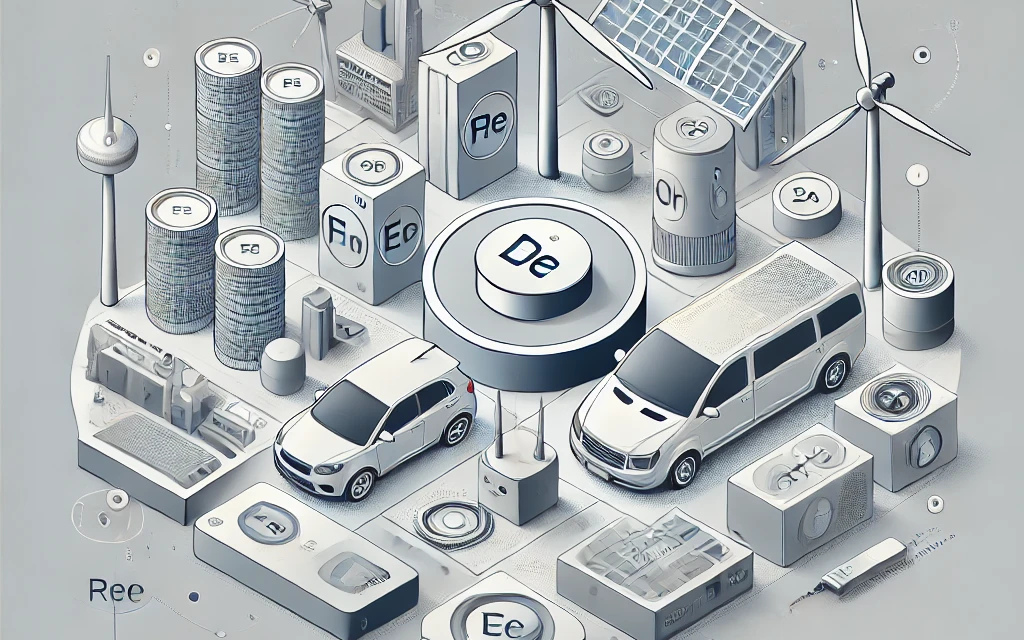
REEs have unique magnetic, luminescent, and catalytic properties, making them indispensable in various high-tech and industrial applications. Their importance can be categorized as follows:
1. Electronics & Consumer Goods
- Smartphones & Tablets: Neodymium, dysprosium, and terbium are used in magnets for speakers and vibration motors.
- Televisions & Displays: Europium and yttrium help produce vivid red and green colors in LED and LCD screens.
- Batteries: Lanthanum is a key component in nickel-metal hydride (NiMH) batteries used in hybrid cars.
2. Renewable Energy & Green Technologies
- Wind Turbines: Neodymium and dysprosium are essential for high-strength permanent magnets in turbines.
- Electric Vehicles (EVs): REEs are critical in the magnets for electric motors in EVs, improving efficiency and reducing weight.
- Hydrogen Storage & Fuel Cells: Some REEs are used in catalysts for hydrogen fuel production.
3. Defense & Aerospace
- Radar & Guidance Systems: REEs are vital for precision-guided missiles and stealth technologies.
- Jet Engines: Yttrium and terbium are used in heat-resistant coatings for aircraft engines.
- Communications & Lasers: REEs enhance optical fiber communication and military-grade laser systems.
4. Oil & Gas Industry
- Catalysts for Refining: Lanthanum and cerium are used in fluid catalytic cracking (FCC) to refine crude oil into gasoline and other fuels.
5. Medical Applications
- MRI Scanners: Gadolinium is used as a contrast agent in magnetic resonance imaging (MRI).
- Cancer Treatment: Some REEs are used in radiation therapies and pharmaceuticals.
Supply Chain Challenges & Geopolitical Importance
- China dominates REE production, controlling about 60–70% of global supply and over 85% of refining capacity.
- Environmental concerns: Mining and processing REEs generate toxic waste, making sustainable extraction a key challenge.
- Strategic importance: The U.S., EU, and other nations are seeking to diversify REE supply chains to reduce dependence on China.
Future Outlook
- Recycling of REEs from electronic waste is being explored to address supply constraints.
- New mining projects in countries like the U.S., Australia, Canada, and India aim to create alternative supply sources.
- Advanced materials research is ongoing to develop substitutes for REEs in some applications.
Rare Earth Elements are the backbone of modern technology, from smartphones to defense systems and renewable energy solutions. Their strategic importance makes them a focal point in global economic and geopolitical discussions, driving efforts to secure sustainable and diversified supply chains.