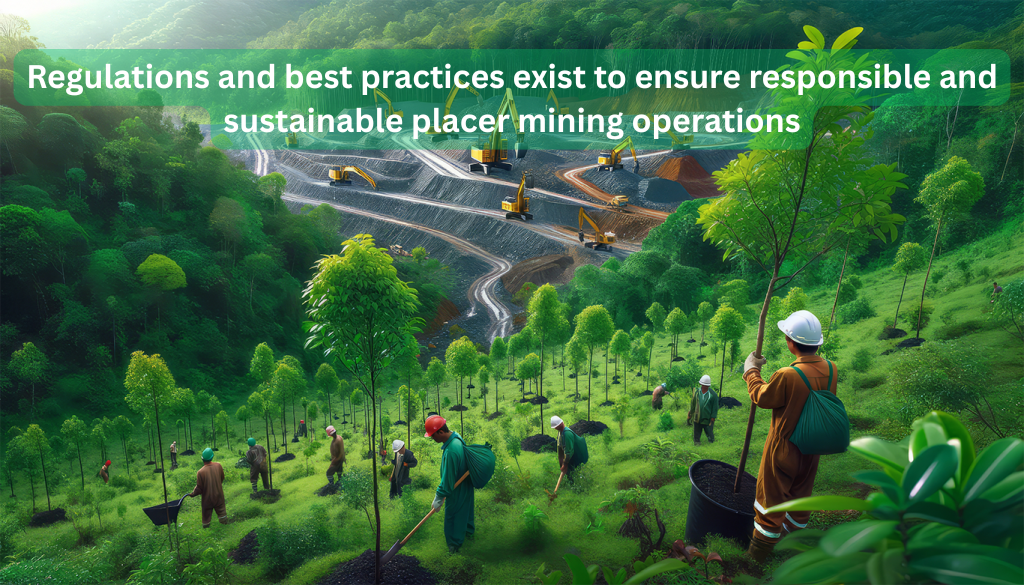
To ensure responsible and sustainable placer mining operations, governments, industry groups, and environmental organizations have developed various regulations and best practices. These aim to minimize the environmental impact, promote the health and safety of workers, and ensure the long-term sustainability of mining activities. Below are some key regulations and best practices that govern placer mining operations:
Regulations Ensuring Responsible Placer Mining
- Environmental Protection and Permitting
- Environmental Impact Assessments (EIAs): Most countries require placer mining operators to conduct a thorough EIA before starting any new mining project. The EIA assesses potential impacts on water quality, ecosystems, and local communities, and outlines how those impacts will be mitigated.
- Requirement: Mining companies must demonstrate how they will minimize sediment runoff, prevent water contamination, and restore habitats.
- Permitting Requirements: Before any mining begins, operators are often required to secure various permits, including:
- Water Use Permits: To regulate water extraction and the discharge of contaminants into water bodies.
- Land Disturbance Permits: To ensure the mining operations will follow sustainable land-use practices.
- Compliance with International Standards: Mining companies may also adhere to international standards, such as those set by the International Finance Corporation (IFC) or the Equator Principles, which help ensure that operations are environmentally and socially responsible.
- Environmental Impact Assessments (EIAs): Most countries require placer mining operators to conduct a thorough EIA before starting any new mining project. The EIA assesses potential impacts on water quality, ecosystems, and local communities, and outlines how those impacts will be mitigated.
- Water Quality Regulations
- Water Discharge Standards: Placer mining operations must meet strict water quality standards to prevent the discharge of pollutants (such as mercury or cyanide) into rivers or coastal areas.
- Regulation of Mercury Use: Some countries, like the United States and Canada, have strict regulations on mercury use in mining (e.g., the Minamata Convention on Mercury), which restricts its use in gold extraction processes.
- Water Treatment Requirements: Regulations may require companies to implement water treatment systems that filter pollutants before discharging water back into the environment.
- Water Discharge Standards: Placer mining operations must meet strict water quality standards to prevent the discharge of pollutants (such as mercury or cyanide) into rivers or coastal areas.
- Wildlife and Habitat Protection
- Protected Areas: Mining operations are prohibited or severely restricted in environmentally sensitive or protected areas, such as national parks, wildlife reserves, or critical habitat zones.
- Riparian Zone Regulations: There are often laws that require operators to maintain a buffer zone along riparian areas (riverbanks or shorelines) to protect vegetation and water quality.
- Species Protection: Placer mining operations are required to assess and mitigate their impact on endangered species or critical habitats in the area.
- Reclamation and Restoration
- Reclamation Plans: Mining operators must submit a detailed reclamation plan that outlines how the land will be restored after mining activities cease. This includes:
- Soil stabilization to prevent erosion.
- Revegetation with native plants to restore local ecosystems.
- Rebuilding habitats for fish and wildlife.
- Bonding Requirements: Governments often require mining companies to set aside funds in the form of a reclamation bond, ensuring that funds are available for land restoration if the company goes bankrupt or fails to meet its environmental obligations.
- Reclamation Plans: Mining operators must submit a detailed reclamation plan that outlines how the land will be restored after mining activities cease. This includes:
- Health and Safety Regulations
- Worker Safety Standards: Placer mining operations must adhere to strict health and safety regulations to protect workers from accidents and exposure to harmful substances, such as mercury or dust.
- Community Health Regulations: Mining companies are often required to monitor air and water quality in surrounding communities to ensure that local populations are not harmed by mining-related pollution.
Best Practices for Sustainable Placer Mining
- Minimizing Environmental Footprint
- Low-Impact Techniques: Use of environmentally friendly methods such as gravity-based separation rather than toxic chemicals (e.g., mercury or cyanide) for mineral recovery.
- Sediment Control: Implementing systems like settling ponds or vegetated buffers to prevent the excessive runoff of sediments into rivers and streams. This ensures that water quality is maintained and habitats are protected.
- Recycling Water: Implementing closed-loop water systems where water is reused in the mining process to minimize water consumption and reduce pollution.
- Water Management
- Monitoring Water Quality: Continuous monitoring of water quality in surrounding rivers and streams to detect any contamination early. This ensures compliance with water discharge standards and allows for quick response to potential issues.
- Use of Eco-Friendly Chemicals: Avoiding or minimizing the use of toxic chemicals such as cyanide and mercury in the mineral extraction process. Where used, companies are encouraged to implement best practices for chemical management to prevent spills and environmental contamination.
- Habitat and Species Protection
- Fish Passage and Habitat Restoration: In riverine areas, mining companies may be required to implement fish passage systems to allow fish to migrate past mining operations. Additionally, efforts should be made to restore aquatic habitats by rebuilding gravel beds for spawning or creating wetlands for wildlife.
- Biodiversity Monitoring: Conducting regular assessments to monitor the health of local ecosystems and species, and taking corrective action if mining activities negatively affect biodiversity.
- Post-Mining Land Use
- Ecosystem Restoration: After mining operations cease, restoring the land to its natural state as much as possible. This may involve revegetating with native species, stabilizing soils to prevent erosion, and returning water bodies to their natural state.
- Community Involvement: Including local communities in post-mining planning, especially in regions where the land is used for agriculture, fishing, or recreation.
- Sustainable Equipment Use
- Energy-Efficient and Low-Emission Equipment: Utilizing modern machinery that is more energy-efficient and produces fewer emissions to reduce the carbon footprint of placer mining operations.
- Automation: Where feasible, automation and remote monitoring technologies can reduce the need for human labor in hazardous environments and improve the efficiency of material recovery, thereby minimizing environmental impacts.
- Transparency and Accountability
- Reporting and Auditing: Transparent reporting of environmental performance, including data on water quality, reclamation efforts, and biodiversity impacts. Regular environmental audits by third-party organizations help ensure compliance with regulations and identify areas for improvement.
- Certification Programs: Participation in sustainability certification programs (e.g., Fairmined, Responsible Jewellery Council) can help demonstrate a commitment to responsible and sustainable mining practices.
Conclusion
To ensure responsible and sustainable placer mining, a combination of rigorous regulations and best practices must be implemented. Key regulations focus on environmental protection, worker health and safety, and reclamation of mined land. Best practices emphasize minimizing environmental impact, protecting habitats, and using eco-friendly techniques. By following these frameworks, placer mining operations can help protect ecosystems and communities while still allowing for the extraction of valuable minerals.
Hashtags
#SustainableMining #ResponsibleMining #MiningRegulations #PlacerMiningBestPractices #EcoFriendlyMining #MiningSustainability #EnvironmentalRegulations #MiningCompliance #SustainableExtraction #MiningStandards #MiningResponsibility #SafeMiningPractices #RegulatedMining #EcoConsciousMining #GreenMiningSolutions #MiningInnovation #CleanMiningTech #MineralResourceManagement #CommunityEngagementInMining #MiningForFuture