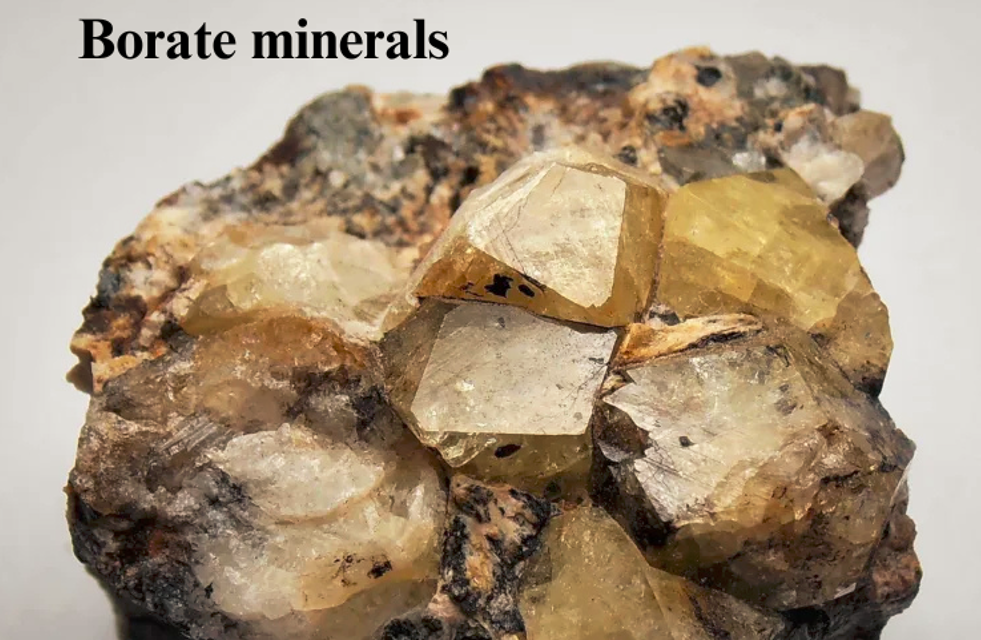
The major borate minerals mined globally are crucial sources of boron for various industrial applications. Each of these minerals has unique properties that make them suited for different uses. Below are the most commonly mined borate minerals and their distinguishing characteristics:
1. Borax (Sodium Borate – Na₂B₄O₇·10H₂O)
- Properties:
- Appearance: Borax is a white crystalline mineral, often found in the form of tussocks or crystalline masses.
- Solubility: Borax is highly soluble in water, which makes it easy to process into various boron compounds.
- Uses: It is the most widely used borate mineral in glass production, detergents, flame retardants, and agricultural fertilizers.
- Key Differentiators: Borax’s high solubility and versatility in producing various boron compounds make it one of the most significant and abundant borate minerals. It is mainly used in boron-rich glass, insulation materials, and ceramics.
2. Colemanite (Calcium Borate – CaB₃O₄(OH)₃·H₂O)
- Properties:
- Appearance: Colemanite is a white to colorless mineral with fibrous or granular textures.
- Hardness: It has a Mohs hardness of 4.5-5, making it somewhat softer compared to other borate minerals.
- Solubility: Less soluble than borax, but still reactive in acidic conditions.
- Uses: Colemanite is primarily used in the production of boron chemicals such as boric acid, sodium borate, and other industrial boron derivatives. It is also important in ceramics and glassmaking.
- Key Differentiators: Colemanite’s high calcium content makes it especially useful in producing specialty boron products. Its low solubility and robust physical properties make it ideal for certain industrial applications like ceramic glazes and fiberglass.
3. Ulexite (Sodium Calcium Borate – NaCaB₅O₆(OH)₆·5H₂O)
- Properties:
- Appearance: Ulexite is often referred to as “TV rock” because it has fiber-optic-like properties, allowing it to transmit light through the mineral. It usually appears as white to colorless fibrous masses.
- Hardness: With a Mohs hardness of 3.5-4, ulexite is soft and can be easily scratched.
- Solubility: Ulexite is soluble in water, and when processed, it can be converted into boric acid or other boron compounds.
- Uses: Due to its optical properties, ulexite has some niche uses in optical and fiber-optic applications, though it is more commonly used in producing boron compounds and as a fluxing agent in glass manufacturing.
- Key Differentiators: Ulexite’s unique optical transmission properties set it apart from other borates. It’s also useful in producing boron-based flame retardants and ceramics.
4. Kernite (Sodium Borate – Na₂B₄O₇·4H₂O)
- Properties:
- Appearance: Kernite is typically found in colorless, white, or pale yellow crystalline forms.
- Hardness: It has a Mohs hardness of 3.5-4, making it relatively soft.
- Solubility: Kernite is soluble in water, though it is less soluble than borax.
- Uses: Kernite is used to produce boric acid, sodium borates, and other boron chemicals. It is also utilized in glass production and ceramics.
- Key Differentiators: Kernite is a high-boron mineral, and its crystal structure makes it easier to process compared to some other borate minerals, making it a valuable source of boron for chemical industries.
5. Pandermite (Calcium Borate – Ca₃B₇O₁₃(OH)₄·3H₂O)
- Properties:
- Appearance: Pandermite occurs as colorless to white crystals or masses.
- Hardness: It has a Mohs hardness of around 4-5, making it relatively soft.
- Solubility: Pandermite is not as soluble in water as borax, but it can be processed to extract boron.
- Uses: Pandermite is mainly used in producing boric acid, boron glass, and boron fertilizers. It’s less commonly used than other borate minerals but still has industrial importance.
- Key Differentiators: Its calcium content makes it slightly different from other borates like colemanite, offering another source of boron for various industrial products.
6. Tincal (Sodium Borate – Na₂B₄O₇·5H₂O)
- Properties:
- Appearance: Tincal is often found as white crystalline masses or powders.
- Solubility: Tincal is highly soluble in water, making it useful in the production of boron chemicals.
- Uses: Primarily used in glassmaking, detergent formulations, and boron chemicals.
- Key Differentiators: Tincal is another important source of boron for various industrial applications like boron-rich glass, ceramic production, and textile industries.
Global Sources of Borate Minerals
Borate minerals are primarily mined in regions where geothermal activity and evaporative basins create high concentrations of boron. The largest global sources of borates are:
- United States: The Mojave Desert in California is home to some of the world’s largest borate deposits, including the Borax mine in Boron, California.
- Turkey: Turkey holds significant reserves of borates, especially in regions like Bigadiç and Kırka, which are rich in colemanite and ulexite.
- Chile: Borate deposits are also found in the Atacama Desert of northern Chile, particularly in the Salar de Atacama region.
- Argentina: The Famatina Valley in Argentina is another important borate-rich region, producing minerals such as colemanite and borax.
- China: China produces significant amounts of borates, although it primarily imports them for processing and distribution.