1. How Halide Mineral Deposits Form
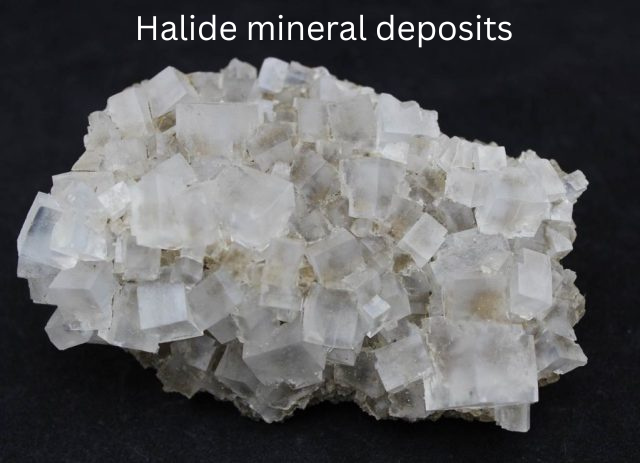
Halide minerals primarily form through evaporation of saline water in enclosed basins, leading to the precipitation of halite (NaCl), sylvite (KCl), fluorite (CaF₂), cryolite (Na₃AlF₆), and other halides. The main formation processes include:
A. Evaporite Deposits (Most Common)
- Process: In hot, arid regions, seawater or saline lake water evaporates, leaving behind concentrated salt deposits.
- Minerals Formed:
- First: Calcite (CaCO₃) and gypsum (CaSO₄·2H₂O) precipitate.
- Next: Halite (NaCl) forms as evaporation increases.
- Last: Sylvite (KCl), carnallite (KMgCl₃·6H₂O), and bischofite (MgCl₂·6H₂O) form as the most soluble salts.
- Examples: Great Salt Lake (USA), Dead Sea (Israel & Jordan).
B. Hydrothermal Veins & Magmatic Processes
- Fluorite (CaF₂) and cryolite (Na₃AlF₆) form in hydrothermal veins associated with volcanic activity.
- Fluoride-rich fluids deposit minerals in fractures of existing rocks.
- Examples: Illinois-Kentucky Fluorspar District (USA), Okorusu (Namibia).
C. Sedimentary Brine Deposits
- Form in underground aquifers rich in dissolved salts.
- These brines can be pumped to extract potash, lithium, and magnesium.
- Examples: Salar de Uyuni (Bolivia), Salar de Atacama (Chile).
Halide minerals primarily form through evaporation of saline water, hydrothermal processes, and brine concentration