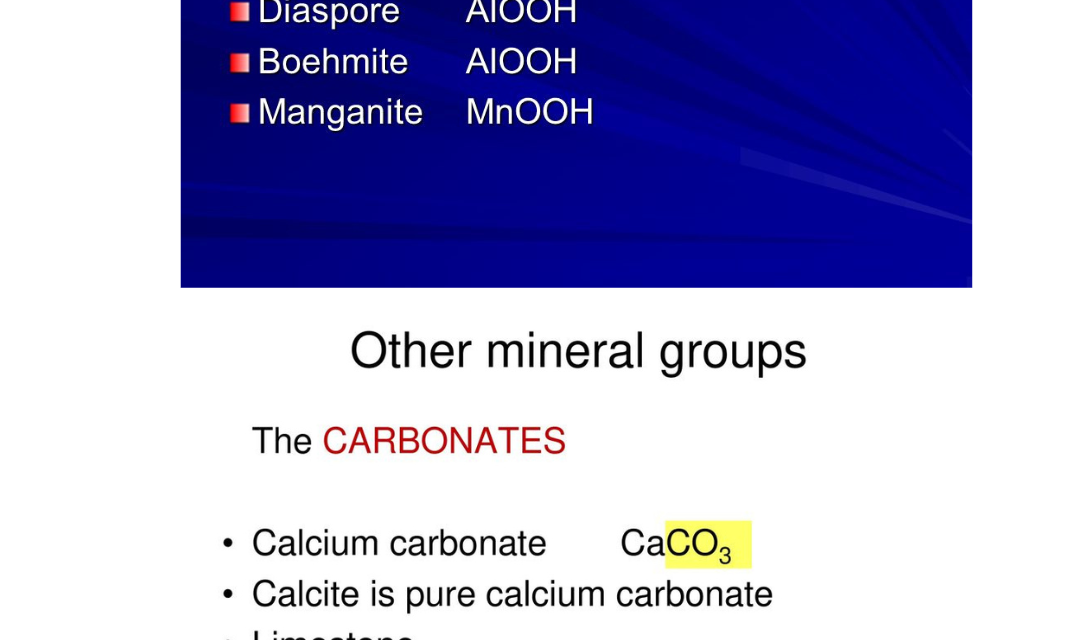
Hydroxide minerals are a group of minerals that contain the hydroxide ion (OH⁻) as part of their structure. In these minerals, the hydroxide ion is chemically bonded to metal cations, and they often form in environments with highly alkaline conditions or through the weathering of other minerals. They are typically distinguished by the presence of hydroxide groups, which set them apart from other mineral groups that do not contain this ion.
Key Characteristics of Hydroxide Minerals:
- Composition:
- Hydroxide minerals consist of metal cations (such as aluminum, iron, or manganese) combined with hydroxide ions (OH⁻).
- The general formula for hydroxide minerals is often represented as [M(OH)ₓ], where M is a metal ion and x is the number of hydroxide ions bonded with the metal.
- Formation:
- Hydroxide minerals commonly form through weathering or oxidation of other minerals, often in acidic or alkaline environments.
- They can also form as a result of hydrothermal activity or during oxidation of metallic ores.
- Structure:
- The hydroxide ion (OH⁻) is typically bonded to metal cations in a way that forms either layers or chains of metal-hydroxide groups. These structures are often quite stable in specific environmental conditions.
- Physical Properties:
- Many hydroxide minerals are soft, and many are characterized by low density. Some have a shiny or greasy appearance, while others may be dull.
- Hydroxide minerals often have good water solubility in their natural environments, making them more prone to weathering than more stable silicate or oxide minerals.
Key Differences from Other Mineral Groups
- Versus Silicate Minerals:
- Silicate minerals are composed primarily of silicon (Si) and oxygen (O) atoms, usually arranged in a tetrahedral structure (SiO₄). These minerals are the most abundant on Earth and make up the majority of the Earth’s crust.
- Hydroxide minerals contain hydroxide ions (OH⁻) and are typically not as structurally complex as silicates. They generally form in secondary environments, such as the alteration of primary minerals, whereas silicates often form in igneous or metamorphic processes.
- Hydroxides are more reactive than silicates and can weather more easily, releasing metal ions into the environment.
- Versus Oxide Minerals:
- Oxide minerals consist of metal cations combined with oxygen (O), rather than hydroxide ions. Examples include hematite (Fe₂O₃) and magnetite (Fe₃O₄).
- The key difference between hydroxides and oxides is that hydroxides contain the hydroxide ion (OH⁻), which gives them distinct properties, including higher water solubility and greater reactivity under certain conditions.
- Oxide minerals are often more stable and more resistant to weathering than hydroxides.
- Versus Sulfate Minerals:
- Sulfate minerals are formed from metal cations combined with the sulfate ion (SO₄²⁻). Examples include gypsum (CaSO₄·2H₂O) and barite (BaSO₄).
- While sulfates involve sulfur in their composition, hydroxide minerals are characterized by the presence of oxygen and hydrogen in the hydroxide ion (OH⁻). This gives them different chemical properties and environmental behaviors, particularly when it comes to their reactivity with water.
Common Hydroxide Minerals and Their Uses
- Gibbsite (Al(OH)₃):
- Formation: Gibbsite is a primary source of aluminum and often forms through the weathering of feldspar or other aluminum-rich minerals.
- Uses: It is a key mineral in the bauxite ore, which is processed to obtain aluminum.
- Goethite (FeO(OH)):
- Formation: Goethite forms as a result of iron oxidation and is a common iron ore.
- Uses: It is used in the production of iron and can also be a source of pigments for dyes due to its reddish-brown color.
- Limonite (FeO(OH)·nH₂O):
- Formation: Limonite is an amorphous mixture of hydrated iron oxides and hydroxides, often forming in weathered iron deposits.
- Uses: It is used as an iron ore and can also be used in the manufacture of paint pigments and steel production.
- Serpentine (Mg₃(Si₂O₅)(OH)₄):
- Formation: Serpentine forms during the alteration of magnesium-rich rocks such as peridotite and dunite.
- Uses: It is used in the production of asbestos (historically), as well as garnishes and stone countertops. It is also of interest for carbon capture due to its ability to absorb CO₂.
Environmental Role of Hydroxide Minerals
- Acid Mine Drainage (AMD): Many hydroxide minerals, especially those containing iron like goethite and limonite, can play a role in acid mine drainage. When sulfide minerals are exposed to oxygen and water, they oxidize and form sulfuric acid. This acid can interact with hydroxide minerals and other compounds, influencing the pH and toxicity of surrounding environments.
- Water Filtration: Some hydroxide minerals, such as gibbsite, can act as natural filters in water, adsorbing heavy metals or other pollutants, making them significant in water treatment and environmental remediation processes.
Hydroxide minerals are an important group in the mineral kingdom, characterized by their chemical composition (containing hydroxide ions, OH⁻) and distinctive formation processes.