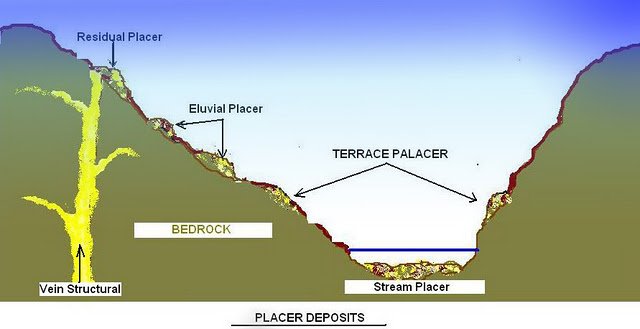
Placer deposits are formed by the natural transportation and deposition of valuable minerals from their original source to new locations through the action of water, wind, or ice. The geological conditions that lead to the formation of placer deposits are primarily associated with the erosion and weathering of rocks and the concentration of heavy minerals in alluvial environments. Here’s an overview of the key geological factors:
1. Weathering and Erosion of Source Rocks
- Primary Source: Placer deposits originate from the weathering of igneous, metamorphic, or sedimentary rocks containing valuable minerals (such as gold, platinum, tin, diamonds, etc.). The weathering process breaks down these rocks into smaller fragments, and mineral grains are liberated from the rock matrix.
- Transport: Once the minerals are freed, they are transported by natural forces such as water (rivers, streams, or floods), glaciers, or even wind. Gold, for instance, is typically released from quartz veins in hard rock formations and carried downstream to form placer deposits.
2. Mineral Density and Size
- Heavy Mineral Concentration: The key to placer deposits is the ability of heavier minerals to accumulate in certain areas due to their density. Valuable minerals like gold, platinum, tungsten, and diamonds are often dense and relatively resistant to weathering.
- As a result, these minerals tend to settle in low-energy environments (such as the bottom of rivers or streams) because they are not easily moved by the flowing water.
- Gold is particularly dense, and during the transportation process, it is less likely to be carried away by the current, accumulating in places where water slows down (e.g., river bends, the inside of meanders, or the base of waterfalls).
3. Erosion of Riverbeds and Stream Channels
- Streambed Conditions: Placer deposits are often found in streambeds, rivers, estuaries, and beaches, where running water is capable of moving large amounts of sediment.
- In these settings, the flow of water sorts materials by size and weight, allowing heavier minerals to settle and concentrate at the bottom or in areas with reduced current velocity.
- Streams with high flow can transport larger materials, while slower moving streams or river sections (such as depositional zones) allow heavier minerals to accumulate, forming placers.
4. Geological Structures and Sediment Traps
- Topography and Channel Features: The geological setting and the topography of a region play an important role in the formation of placer deposits. These features influence the movement of water and the deposition of sediment.
- Meanders, pools, and riffles in river channels create natural zones where heavier minerals can settle, such as the inside of bends where water slows down, or natural obstacles like rocks or logs that act as barriers to sediment transport.
- Alluvial fans, delta areas, glacial deposits, and beaches can also concentrate placer minerals in distinct layers due to changes in water velocity.
5. Glacial Activity (Glacial Placers)
- Glacial Erosion: In some regions, glaciers are responsible for moving large amounts of sediment and minerals from mountainous or glaciated areas. When glaciers retreat, they leave behind glacial deposits (known as drift), which may contain placer minerals, especially gold and diamonds.
- The movement of ice and the deposition of meltwater often result in the formation of glacial placers, where minerals are concentrated in till deposits or outwash fans. These deposits can be highly valuable, especially in areas where glaciers have transported precious metals from ancient ore bodies.
6. Oceanic and Coastal Processes
- Beach Placers: In coastal regions, wave action and tides can concentrate heavy minerals on beaches, forming beach placers. Here, ocean currents move sediment, and heavier minerals like ilmenite, zircon, and gold settle in the sand and gravel.
- Heavy minerals are often concentrated in high-energy zones along the coast, particularly in places where the ocean has eroded inland deposits and deposited them back onto the beach or sandbars.
Common Locations of Placer Deposits
Placer deposits are found in regions with the following geological features:
- Riverbeds and Streams: Areas with active river systems, particularly those with high erosion potential, often contain placer deposits. These rivers transport materials from upstream and concentrate them in alluvial fans, delta plains, and riverbeds.
- Famous examples include the Klondike River in Canada and the California Gold Rush regions in the United States.
- Glaciated Regions: Areas previously covered by glaciers, such as parts of Alaska, Canada, and Scandinavia, have placer deposits left behind by glacial action.
- Examples include the Yukon in Canada, known for its gold placers from ancient glacier movement.
- Beaches and Coastal Zones: In coastal regions and along rivers, the action of waves, tides, and ocean currents can create placer deposits of heavy minerals.
- Notable examples include beach placers of ilmenite, rutile, and zircon in places like India, Sri Lanka, and South Africa.
- Mountainous Regions: In areas with active erosion, such as mountain foothills, placer deposits may be found at the base of mountain ranges where streams and rivers carry minerals from the source rocks.
- This is particularly common for gold, tin, and platinum.
Conclusion
Placer deposits form under specific geological conditions where heavy, durable minerals are transported by natural forces (water, glaciers, or wind) and concentrated in locations with low energy where the mineral grains can settle. These conditions are commonly found in riverbeds, streams, beaches, glacial deposits, and alluvial fans. The primary factors leading to the formation of placer deposits are erosion, weathering, mineral density, and sediment sorting. As a result, placer deposits are often rich in valuable minerals like gold, diamonds, tin, and platinum, and are commonly found in regions with active hydrological or glacial processes.
Hashtags
#PlacerDeposits #GeologicalConditions #GoldDeposits #AlluvialDeposits #MineralDeposits #SedimentaryDeposits #PlacerGold #RiverGold #MiningGeology #GeologyOfGold #AlluvialMining #GoldRush #PlacerMiningRegions #NaturalMinerals #GoldExploration #MiningIndustry #GeologicalSurvey #MineralResources #GoldProspecting #SustainableMining