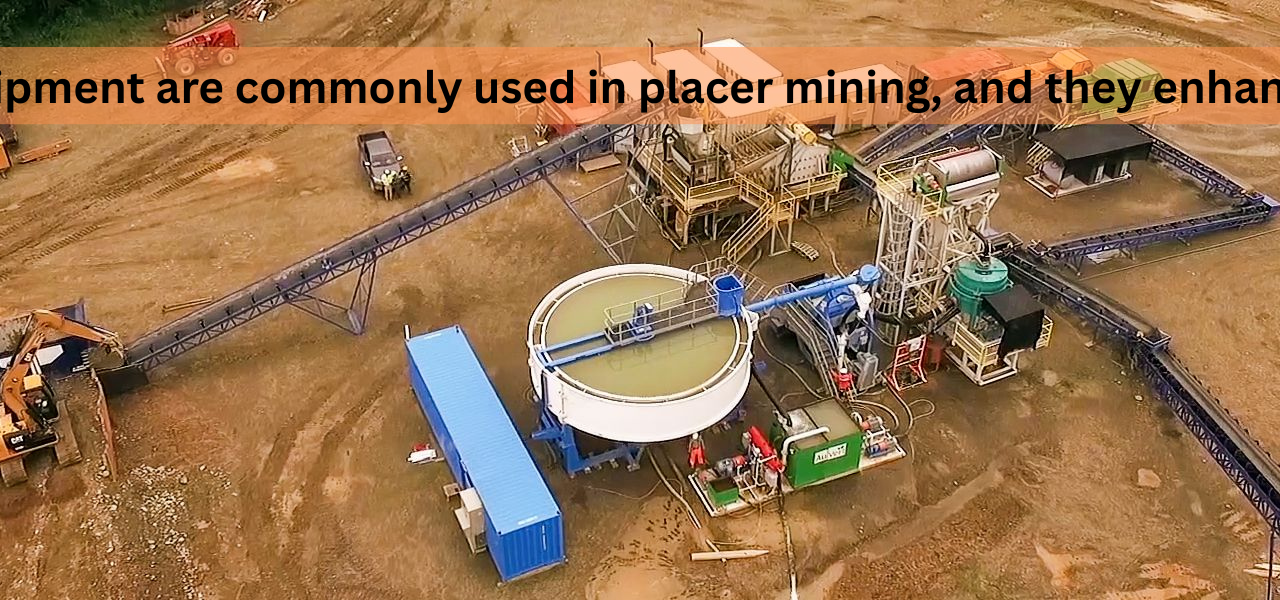
In placer mining, various types of equipment are used to excavate, transport, and process the alluvial materials to recover valuable minerals, such as gold, diamonds, platinum, and gems. The equipment is designed to handle the specific challenges of working with loose, unconsolidated materials and to efficiently separate heavier minerals from lighter ones. Here’s an overview of the most commonly used equipment and how they enhance the efficiency and recovery rates of placer mining operations:
1. Panning (Manual Equipment)
- Description: Panning is the simplest and most traditional method of placer mining, where a miner uses a shallow pan to wash gravel and sediment in water, allowing the heavier minerals to settle to the bottom.
- Efficiency: This method is low-cost and effective for small-scale operations or prospecting. However, it is time-consuming and less efficient for large-scale operations.
- Recovery Rate: High recovery for small quantities of heavy minerals (like gold) in low-flow areas or in shallow placer deposits.
2. Sluice Box
- Description: A sluice box is a long, narrow trough with riffles or bars at the bottom. Water is passed through the sluice, and as the sediment moves, the heavier minerals (e.g., gold) settle behind the riffles while lighter materials are carried away.
- Efficiency: Sluice boxes are effective at processing large volumes of material with relatively low labor intensity. They can be used in both small-scale and larger operations.
- Recovery Rate: Sluice boxes can achieve a high recovery rate (80-90%) when set up correctly, as they efficiently trap heavy minerals, especially in shallow placer deposits.
3. Trommel (Rotary Screen)
- Description: A trommel is a rotating drum with holes in it that sorts material by size. The material is fed into the rotating drum, and as the drum turns, larger rocks and debris are separated from the finer material. The finer materials are then passed onto other processing equipment for further separation.
- Efficiency: Trommels enhance efficiency by pre-screening the material and separating finer gravel and sediment from larger rocks. This reduces the burden on downstream equipment (like sluice boxes or jigs).
- Recovery Rate: Trommels improve recovery by enabling the system to focus on the finer materials where gold and other valuable minerals are concentrated. They are often used in large-scale placer operations.
4. Dredges (Hydraulic and Mechanical)
- Description: A dredge is a machine used to excavate material from the riverbed and can be either hydraulic or mechanical:
- Hydraulic Dredges: Use high-pressure water jets to dislodge and transport materials to a processing plant.
- Mechanical Dredges: Use a bucket or scoop mechanism to collect material, which is then transported to the processing area.
- Efficiency: Dredges are highly efficient for large-scale operations that work in deeper water or underwater placer deposits. They can continuously mine and process material without the need for manual labor.
- Recovery Rate: When combined with proper processing methods (such as sluice boxes or jigs), dredges can achieve high recovery rates and efficiently process large volumes of material.
5. Jigs
- Description: A jig is a gravity separation device that uses pulsating water to separate heavy minerals from lighter materials. The jig consists of a sieve-like container, and as the water pulsates, the heavier minerals (such as gold) are forced downward, while the lighter materials are lifted.
- Efficiency: Jigs are particularly effective for recovering fine gold and other heavy minerals that may not be effectively separated by sluice boxes. They are widely used in large-scale operations.
- Recovery Rate: Jigs can achieve high recovery rates, especially when fine gold is present. Recovery rates typically range from 85-95%, depending on the mineral content and the setup.
6. Shaker Tables (Wilfley Tables)
- Description: A shaker table is a flat, inclined surface that uses a shaking motion to separate materials based on their density. The table has riffles or grooves that trap the heavier minerals as the material is passed over the surface.
- Efficiency: Shaker tables are highly efficient for fine gold recovery and are often used in conjunction with other equipment (like jigs or sluice boxes). They provide a high level of sorting and are used in both small and large operations.
- Recovery Rate: Shaker tables can achieve high recovery rates of fine gold (90% or more), making them ideal for operations focusing on fine placer gold.
7. Centrifugal Concentrators
- Description: Centrifugal concentrators (e.g., Knelson concentrators) use centrifugal force to separate heavier minerals from lighter materials. The process involves spinning the material at high speeds, causing the heavy minerals to settle while the lighter material is expelled.
- Efficiency: These concentrators are efficient at recovering fine gold and other heavy minerals in low-grade placer deposits. They are commonly used in small to medium-scale operations.
- Recovery Rate: Centrifugal concentrators can achieve very high recovery rates (95-98%) for fine gold and other heavy minerals, especially when dealing with low to medium-grade placer deposits.
8. Hydraulic Excavators and Front-End Loaders
- Description: Hydraulic excavators and front-end loaders are used to excavate and load material into sluice boxes, trommels, or other processing equipment. These machines are often used to move large quantities of material quickly and efficiently.
- Efficiency: These machines increase the excavation speed and material handling in larger-scale operations, reducing the need for manual labor and enhancing overall productivity.
- Recovery Rate: While not directly related to recovery, these machines support the overall efficiency of placer mining by allowing the rapid processing of material, which enhances the recovery rate of downstream equipment.
9. Wet Screens and Vibrating Screens
- Description: Wet screens and vibrating screens are used to separate materials based on size before they enter the main processing equipment. These screens filter out larger rocks and debris, allowing only the finer material to pass through.
- Efficiency: They enhance efficiency by pre-screening materials and ensuring that only the appropriate sizes of material are processed in downstream equipment, such as sluice boxes or concentrators.
- Recovery Rate: While not directly improving recovery rates, vibrating screens help optimize the overall process, ensuring cleaner separation of valuable minerals.
Conclusion
The equipment used in placer mining varies depending on the scale of operation and the type of placer deposit being worked. Each piece of equipment is designed to improve efficiency by speeding up material processing, enhancing separation, and maximizing recovery rates. The combination of sluice boxes, dredges, jigs, shaker tables, and centrifugal concentrators ensures that placer miners can recover the highest percentage of valuable minerals from the mined material, from coarse particles to fine gold or diamonds. By choosing the right equipment and optimizing the mining process, placer mining operations can achieve high efficiency and recovery rates, making the extraction of valuable minerals more economically viable.
Hashtags
#PlacerMiningEquipment #GoldPanningGear #MiningEfficiency #GoldRecovery #DredgesAndDraglines #SluiceBoxes #Highbankers #PlacerMiningTech #MiningTools #GoldExtraction #MiningRecoveryRates #EfficientMining #MiningInnovation #GoldDredging #MiningAutomation #ProspectingGear #GoldRush #MinerLife #SustainableMining #MiningCommunity