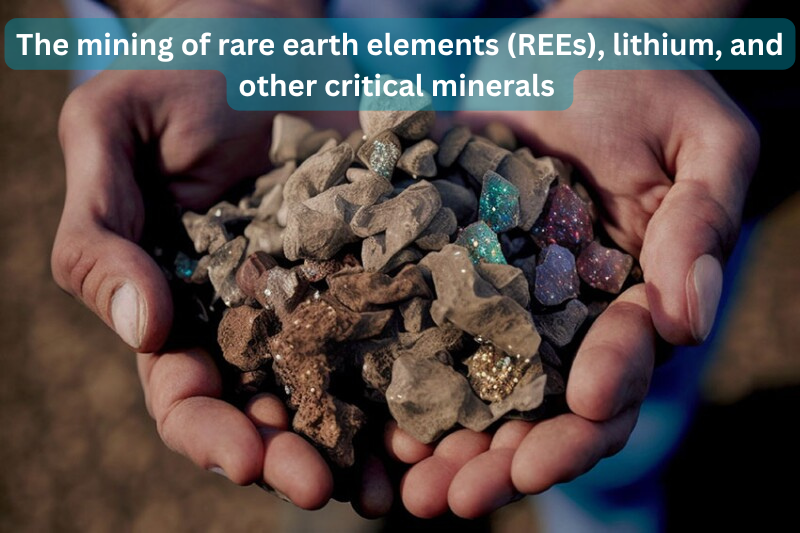
The mining of rare earth elements (REEs), lithium, and other critical minerals fits squarely into the category of specialty mining due to the unique challenges and requirements involved in extracting these materials. Unlike conventional mining, which often focuses on abundant resources like coal or iron ore, specialty mining methods for these critical minerals focus on more precise, efficient, and environmentally mindful techniques for extracting relatively scarce, high-value materials from specific and often hard-to-reach deposits.
Why REEs, Lithium, and Critical Minerals Require Specialty Mining:
- Geological Distribution:
- REEs, lithium, and critical minerals are often found in small, dispersed deposits or in ores with low concentrations, making large-scale conventional mining uneconomical.
- These minerals may be locked in complex ores or situated in remote or deep deposits, requiring advanced techniques to extract them efficiently.
- Environmental Concerns:
- Many of these minerals are located in environmentally sensitive areas (e.g., deep-sea beds, pristine forests) or in regions with strict regulations. As such, mining these materials requires methods that minimize environmental impact compared to traditional methods like open-pit or underground mining.
- High Economic Value:
- REEs, lithium, and critical minerals like cobalt and graphite are crucial for the production of advanced technology such as electric vehicle (EV) batteries, solar panels, and electronics, making their extraction highly valuable. This justifies the use of specialized techniques to ensure that every bit of these minerals can be recovered.
Techniques and Methods in Specialty Mining for Critical Minerals:
- In-Situ Recovery (ISR) for Lithium and REEs:
- ISR is often used for extracting lithium from brines in salt flats or underground reservoirs. A solution is injected into the mineral deposit, dissolving the lithium, which is then pumped to the surface for processing.
- This technique is particularly suited for lithium extraction from brine sources found in places like the Lithium Triangle (Argentina, Bolivia, and Chile), as well as some rare earth deposits.
- Advantages: Low surface disturbance, reduced water usage compared to traditional mining, and the ability to recover lithium from low-concentration deposits.
- Selective Leaching and Bioleaching for REEs:
- Selective leaching and bioleaching use specialized chemical or biological processes to selectively dissolve the target minerals while leaving waste materials behind.
- For REEs, bioleaching can be applied to low-grade ores where traditional extraction methods (such as smelting) would be inefficient or environmentally harmful. Microorganisms are used to break down ore and release valuable metals like neodymium, dysprosium, and praseodymium.
- Advantages: This method is more environmentally friendly, uses less energy, and can process ores that are not viable with conventional techniques.
- Hydrometallurgical Processing for Lithium and REEs:
- This involves the use of aqueous solutions (e.g., acids) to extract minerals from ores. Lithium extraction is often carried out through acid leaching, where ore is treated with an acid to separate the lithium.
- For REEs, hydrometallurgical techniques are used to separate and purify individual elements from complex ores.
- Advantages: More precise and selective than traditional mining techniques, with the ability to target specific minerals and reduce waste.
- Borehole Mining for REEs and Critical Minerals:
- Borehole mining involves drilling vertical or horizontal boreholes into the ore body and using high-pressure water or air to dislodge minerals, which are then pumped to the surface.
- This method can be applied to extracting REEs from deep, complex deposits that might be otherwise difficult to access with conventional mining.
- Advantages: Minimal surface disturbance, less waste rock, and the ability to target specific ore zones without removing large volumes of material.
- Marine Mining for Critical Minerals (e.g., Polymetallic Nodules):
- Mining of polymetallic nodules, which contain cobalt, nickel, copper, and rare earth elements, is a developing area within specialty mining. These nodules are found on the deep ocean floor and are extracted using remotely operated vehicles (ROVs) and specialized suction or cutting equipment.
- Advantages: Access to rich mineral deposits in the ocean that are difficult to mine via conventional methods, potentially reducing land-based environmental degradation.
- Hydraulic Mining for Lithium and Cobalt:
- Hydraulic mining uses high-pressure jets of water to dislodge materials from ore bodies. While typically associated with gold, hydraulic mining techniques can be adapted for lithium extraction from certain clay deposits or cobalt from low-grade ores.
- Advantages: Efficient in recovering minerals from low-grade ores with minimal physical effort, though it may have environmental implications if not carefully managed.
Key Benefits of Specialty Mining for REEs, Lithium, and Critical Minerals:
- Environmental Efficiency:
- Specialty mining methods like ISR and bioleaching are more sustainable than traditional mining, as they minimize land disruption and can often be more water- and energy-efficient.
- Access to Low-Grade and Remote Deposits:
- Techniques like ISR, borehole mining, and marine mining allow the extraction of minerals from deposits that are too deep, low-grade, or dispersed to be mined profitably using conventional methods.
- Higher Recovery Rates:
- These methods are often more selective, which means they can recover a higher percentage of valuable minerals from the ore while leaving waste behind, maximizing resource utilization.
- Reduced Surface Impact:
- Compared to large-scale open-pit or underground mining, many specialty mining techniques—especially those using chemical or biological processes—minimize the environmental footprint.
Industries That Rely on Critical Minerals:
- Electronics: Lithium, REEs (for magnets, capacitors, etc.), and cobalt are used in smartphones, laptops, LED displays, and other devices.
- Electric Vehicles: Lithium-ion batteries require lithium, nickel, cobalt, and graphite. Rare earth elements are used in high-performance EV motors.
- Renewable Energy: REEs are vital in the manufacture of wind turbines (permanent magnets) and solar panels (for energy storage and conversion).
- Defense: REEs are essential for precision-guided weapons, radar systems, and advanced communications technology.
- Aerospace: Critical minerals like tantalum and niobium are used in aerospace components that must withstand extreme conditions.
Conclusion:
Mining of REEs, lithium, and other critical minerals involves specialized techniques that go beyond traditional mining methods due to the specific challenges of resource scarcity, low-grade ores, and environmental sensitivity. These minerals are crucial for the advancement of technology in sectors like renewable energy, electronics, and electric vehicles, making the adoption of specialty mining methods essential for meeting global demand sustainably and efficiently.
Hashtags
#SpecialtyMining #CriticalMinerals #RareEarthMining #LithiumMining #MineralExtraction #SpecialtyMinerals #REEsExtraction #SustainableMining #HighTechMining #MiningForTheFuture #GreenMining #MineralResources #EcoFriendlyMining #MiningInnovation #FutureOfMining #CleanEnergyMetals #MiningTechnology #ResourceSustainability #MineralSupplyChain #ResponsibleMining