Surface mining has evolved significantly over time with advancements in technology and equipment that improve efficiency, safety, and environmental sustainability. The key technologies and equipment used in surface mining include various machines for excavation, transportation, and processing, as well as innovations that enhance productivity and reduce environmental impact. Here’s an overview of these technologies and equipment, along with their evolution:
1. Excavation and Material Removal Equipment
Excavation and material removal are the primary tasks in surface mining. The equipment used for these tasks has evolved to handle larger volumes of material more efficiently, while also improving safety and reducing costs.
a) Shovels and Hydraulic Excavators
- Early Technology: Early surface mining operations used steam-powered shovels, which were slow and inefficient.
- Modern Technology: Hydraulic excavators and electric rope shovels have replaced older models, offering more power and greater efficiency.
- Hydraulic Excavators: These machines use hydraulic systems to lift and move large volumes of material. They can be used for digging, loading, and lifting operations.
- Electric Rope Shovels: Large-scale mining operations often use electric rope shovels, which are more powerful and efficient for removing large amounts of overburden and ore.
- Evolution: These machines have become more automated and energy-efficient over time, with larger buckets and greater digging capacities.
b) Draglines
- Early Technology: Draglines were initially powered by steam engines but have since evolved to be electrically powered.
- Modern Technology: Today’s draglines are massive, electrically powered machines that are capable of moving millions of cubic meters of material per day.
- Usage: Primarily used in coal mining and other surface mining operations to remove large volumes of overburden (soil and rock) above ore bodies.
- Evolution: Draglines have grown significantly in size, with modern models able to move up to 100 cubic yards of material in a single scoop.
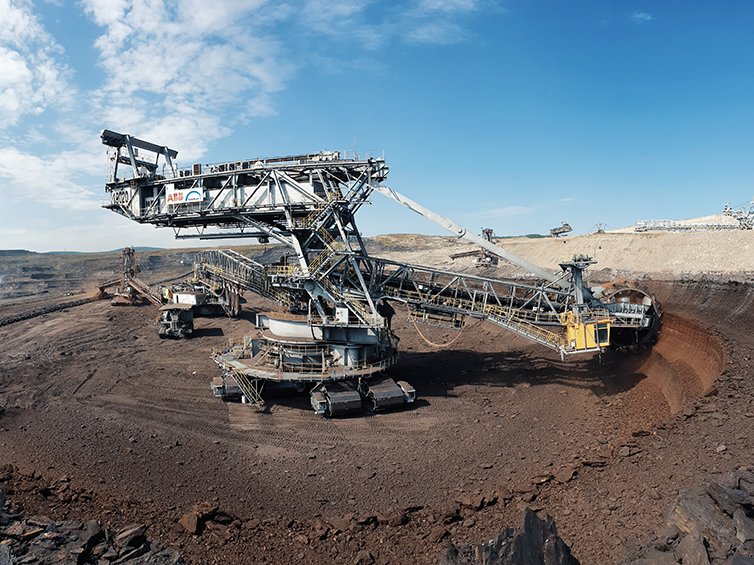
c) Bucket Wheel Excavators
- Early Technology: Bucket wheel excavators first appeared in the early 20th century but were initially limited in their capacity.
- Modern Technology: These machines have evolved to have larger, more durable bucket wheels and efficient power systems.
- Usage: Often used in mining applications where there is a need to remove large amounts of material quickly, such as in strip mining or lignite mining.
- Evolution: Modern bucket wheel excavators have improved automation and are more capable of working in difficult terrain.
2. Hauling and Transportation Equipment
Efficient transportation of materials from the mine site to processing facilities or storage areas is critical. Over time, surface mining has seen improvements in hauling equipment, with innovations in automation and fuel efficiency.
a) Haul Trucks
- Early Technology: Early haul trucks were small and relatively inefficient, requiring large crews and frequent refueling.
- Modern Technology: The advent of ultra-class haul trucks has revolutionized surface mining. These trucks are massive, with capacities of up to 400 tons, and are powered by diesel engines or increasingly by electric drivetrains for reduced emissions and operational costs.
- Evolution: Haul trucks now feature automated driving systems, GPS navigation, and real-time monitoring systems to optimize routes and reduce fuel consumption. Electric and hybrid models are being developed for greater energy efficiency and lower carbon emissions.
- Example: Trucks like Caterpillar 797F (400 tons capacity) and Komatsu 930E (250 tons capacity) are examples of ultra-class trucks used in modern surface mining.
b) Conveyor Systems
- Early Technology: Early conveyor systems were simple belt systems that moved material from mining operations to processing plants.
- Modern Technology: Conveyor systems have evolved to be larger, more durable, and capable of handling increased material throughput.
- Usage: Conveyor belts are widely used in surface mining to transport materials over long distances, reducing the need for haul trucks in certain cases.
- Evolution: The integration of automated controls and real-time monitoring systems has improved the efficiency and reliability of these systems.
3. Drilling and Blasting Equipment
Drilling and blasting are used to break up rock or ore to make the material easier to excavate and transport.
a) Rotary and Percussion Drills
- Early Technology: Early surface mining used hand-held drills and steam-powered equipment for drilling.
- Modern Technology: Rotary drills and hydraulic percussion drills have replaced older equipment. These drills are capable of handling much harder rock and creating more precise drill holes for blasting.
- Evolution: Drills have become more powerful, precise, and automated. Directional drilling technology allows for more controlled blast patterns, reducing waste and improving ore recovery.
b) Blasting Systems
- Early Technology: Explosives were initially used in surface mining, but the methods for detonating and timing were rudimentary.
- Modern Technology: Modern blasting systems use digital detonation systems that allow for precise control over the timing and size of the blast, improving safety and efficiency. Seismic monitoring is also used to reduce the risk of accidental rock falls and ensure that blasts are conducted safely.
- Evolution: Blasting techniques have become more sophisticated, with automated systems for blasting pattern optimization and real-time monitoring to ensure environmental compliance.
4. Mineral Processing Equipment
Once the materials are excavated and transported, they need to be processed to extract the valuable minerals. Modern surface mining operations use a variety of advanced processing equipment.
a) Crushers and Grinding Mills
- Early Technology: Early crushers were simple mechanical devices that broke ore into smaller pieces, but they were inefficient.
- Modern Technology: Modern crushers and grinding mills use advanced technology such as high-pressure grinding rolls (HPGR) and semi-autogenous grinding (SAG) mills, which offer higher efficiency and greater throughput.
- Evolution: These mills are equipped with automation systems to optimize grinding performance and minimize energy consumption.
b) Flotation Cells and Gravity Separation Systems
- Early Technology: Early flotation systems were manually operated, requiring a lot of labor and resulting in lower recovery rates.
- Modern Technology: Automated flotation cells and gravity separation systems now allow for more precise and efficient recovery of valuable minerals from ore, improving recovery rates and minimizing waste.
- Evolution: Modern flotation systems incorporate real-time data collection and analysis, enhancing recovery performance and reducing environmental impact.
5. Environmental Control and Monitoring Technologies
With increasing environmental concerns, mining operations have integrated more advanced technologies to reduce their impact.
a) Dust Suppression Systems
- Early Technology: Water sprays were initially used to suppress dust, but they were often inefficient and inconsistent.
- Modern Technology: Automated dust suppression systems that use water misting, foam, and other techniques are now common, offering more effective control over dust emissions. Air filtration systems are used in mining equipment to protect operators and reduce particulate matter.
- Evolution: Technologies such as dust collectors and water-based misting systems have become more sophisticated and are now integrated into mining equipment for continuous dust suppression.
b) Water Management Systems
- Early Technology: Water management was a less considered aspect of mining, leading to inefficient use of water resources.
- Modern Technology: Mines now utilize advanced water treatment and recycling systems to reduce consumption and prevent contamination of nearby water bodies. Reverse osmosis and constructed wetlands are increasingly used for water purification.
- Evolution: Modern water treatment systems are more efficient, allowing for a higher rate of water recycling and reducing environmental impact.
6. Automation and Digital Technologies
The mining industry has increasingly incorporated automation and digital technologies to improve safety, reduce costs, and increase efficiency.
- Automated Haulage Systems: Autonomous haul trucks and other vehicles are becoming common in large-scale surface mining operations. These vehicles are equipped with sensors and GPS systems for safe, efficient, and optimized operations.
- Real-time Monitoring: The integration of Internet of Things (IoT) sensors and machine learning algorithms enables real-time monitoring of equipment performance, helping to predict failures and optimize operations.
- Drones and Remote Sensing: Drones are used for surveying and mapping, providing detailed 3D models of mining sites, monitoring land reclamation, and inspecting difficult-to-reach areas. LiDAR and satellite imagery are also used for environmental monitoring.
Conclusion
The evolution of surface mining technology has been driven by the need for higher efficiency, lower operational costs, and reduced environmental impact. Modern surface mining operations use advanced machinery for excavation, hauling, drilling, processing, and environmental management. Automation, digital technologies, and environmentally friendly practices are reshaping the industry, leading to safer and more sustainable mining operations. As technology continues to evolve, further innovations in energy efficiency, waste management, and real-time data integration will likely continue to improve the efficiency and sustainability of surface mining.
Hashtags
#SurfaceMiningTech #MiningEquipment #MiningInnovation #EvolutionInMining #MiningTechnology #ExcavatorsAndLoaders #MiningMachinery #OpenPitMining #AdvancedMiningTech #MiningEfficiency #MiningAutomation #SmartMining #HeavyMiningEquipment #SustainableSurfaceMining #MiningEquipmentEvolution #MiningIndustry #MiningSolutions #EcoFriendlyMining #MiningSafety #FutureOfMining