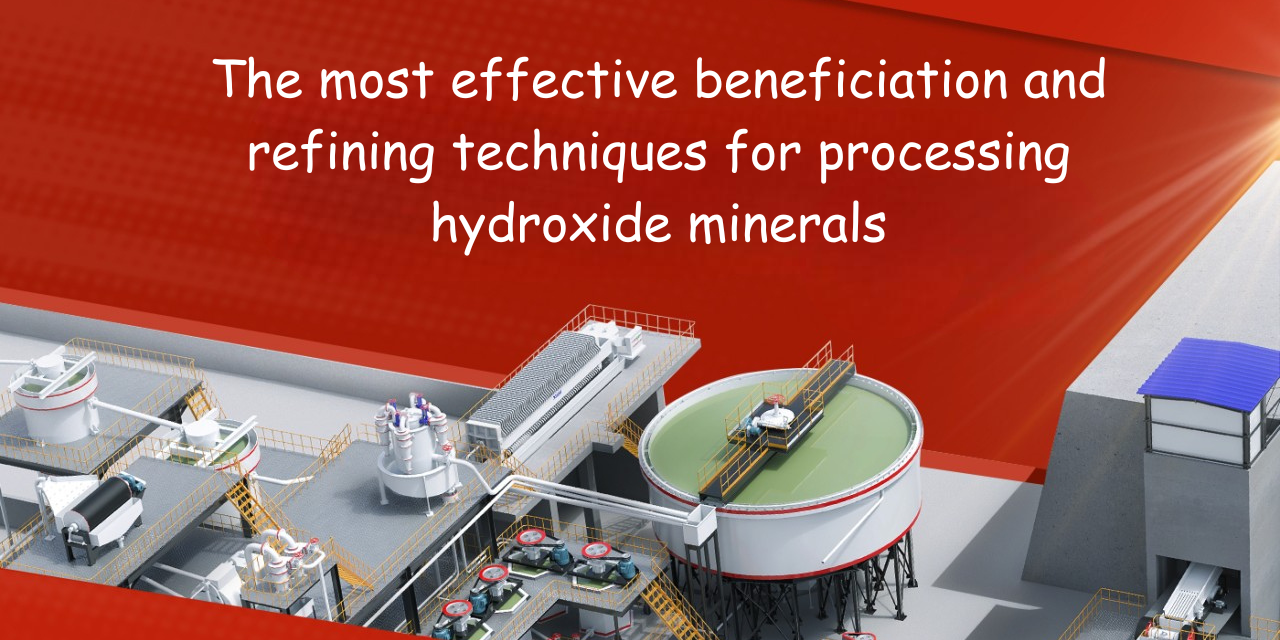
Beneficiation and refining of hydroxide minerals—such as gibbsite (aluminum hydroxide), goethite (iron hydroxide), and brucite (magnesium hydroxide)—require specialized techniques due to their unique chemical and physical properties. The goal is to separate valuable metals from gangue minerals, remove impurities, and prepare the material for the next steps in metal extraction. Below are the most effective beneficiation and refining techniques used for processing hydroxide minerals:
1. Beneficiation Techniques for Hydroxide Minerals
a. Crushing and Grinding
- Crushing and grinding are the initial steps in beneficiation to reduce the particle size of the ore. This process allows for better liberation of the hydroxide minerals from gangue materials, which is critical for subsequent separation techniques.
- Gibbsite (bauxite), goethite (iron ore), and brucite are usually subjected to crushing to break the ore into smaller pieces followed by grinding to a finer size that facilitates easier mineral separation.
b. Gravity Separation
- Gravity-based methods like jigging, spiral classifiers, and shaking tables can be employed to separate heavier hydroxide minerals from lighter gangue materials. This technique is especially effective when the ore contains minerals with different densities.
- Bauxite (gibbsite) is often separated from clay and silica using density-based separation, as silica and clay are much lighter than gibbsite.
- Goethite can be separated from quartz and other gangue materials using gravity methods.
c. Flotation
- Flotation is an important beneficiation technique for processing hydroxide minerals, especially when dealing with ores that contain a combination of hydroxide and oxide minerals.
- Bauxite flotation may involve the use of collectors, such as ammonium ions, to selectively float gibbsite while allowing silica and iron oxides to sink.
- For goethite, flotation may be used in conjunction with other methods, such as magnetic separation, to further concentrate iron ore.
- Brucite (magnesium hydroxide) ores can also be treated by flotation to separate the magnesium minerals from gangue silicates.
d. Magnetic Separation
- Magnetic separation can be used to separate magnetic minerals, such as goethite or magnetite, from non-magnetic gangue.
- Goethite may exhibit weak magnetic properties under certain conditions. If present with magnetite or hematite, it can be separated using a low-intensity magnetic separator.
e. Washing and Screening
- Washing and screening are used to remove fine clay particles or other impurities from the ore.
- Bauxite ore often requires washing to remove fine clay, silicates, and other contaminants that could hinder further processing or reduce the efficiency of the Bayer process.
2. Refining Techniques for Hydroxide Minerals
a. Bayer Process (For Bauxite)
- The Bayer process is the primary refining method for processing bauxite (aluminum hydroxide), and it specifically targets the extraction of alumina (Al₂O₃) from gibbsite.
- In this process, the crushed bauxite is mixed with caustic soda (NaOH) at high temperature and pressure, which dissolves the aluminum hydroxide in the form of sodium aluminate.
- The remaining impurities (such as iron oxides, silica) form a residue known as red mud, which must be managed as a waste product.
- The sodium aluminate solution is then cooled and seeded to precipitate the aluminum hydroxide (gibbsite), which is then calcined to produce alumina.
b. Direct Reduction (For Iron Hydroxides)
- Goethite, an iron hydroxide, can be processed through direct reduction in a blast furnace or direct reduction furnace to produce pig iron.
- Goethite and other iron hydroxides are reduced by carbon (from coke) at high temperatures, typically around 1500°C, to form iron and carbon dioxide. The non-iron materials form slag and must be separated.
- Direct reduction methods like shaft furnaces or rotary kilns are also used, especially for ores with lower iron content.
c. Leaching (For Magnesium and Other Hydroxides)
- Leaching involves using a solvent to dissolve the hydroxide minerals and extract valuable metals.
- For brucite (magnesium hydroxide), ammonium chloride (NH₄Cl) or hydrochloric acid (HCl) can be used to leach magnesium from the ore. The dissolved magnesium is then extracted as magnesium chloride, which can later be reduced to produce magnesium metal.
- Iron hydroxides (such as goethite) can also undergo acid leaching with sulfuric acid to remove impurities or to convert the iron to a more soluble form, such as ferric sulfate or ferric chloride.
d. Calcination (For Gibbsite)
- Calcination is a crucial step in the refining of gibbsite (aluminum hydroxide) to produce alumina (Al₂O₃).
- After gibbsite is precipitated from the Bayer process, it is heated to high temperatures (1000–1100°C) in a rotary kiln or fluidized bed furnace to drive off the water molecules, leaving alumina.
- The alumina can then be further refined or smelted using electrolytic reduction (the Hall-Héroult process) to produce aluminum metal.
e. Roasting (For Iron Hydroxides and Other Oxides)
- Roasting involves heating the hydroxide mineral at elevated temperatures in the presence of air or a reducing atmosphere to drive off water and convert the hydroxide into an oxide.
- In the case of goethite, roasting is used to convert the iron hydroxide into iron oxide (hematite), which is easier to process in the blast furnace for iron production.
3. Emerging and Advanced Techniques for Hydroxide Mineral Processing
a. Hydrometallurgical Leaching
- Hydrometallurgical techniques such as pressure oxidation or bioleaching may be used to extract metals from hydroxide minerals under high pressure or with the help of microorganisms.
- For example, bioleaching may use microorganisms to assist in the breakdown of iron or aluminum hydroxides, reducing the need for harsh chemicals.
- In some cases, ionic liquids or green solvents are being explored as alternatives to traditional chemical leaching agents, offering more environmentally friendly methods for hydroxide mineral extraction.
b. Solvent Extraction
- Solvent extraction (SX) is gaining attention as a method for refining aluminum and magnesium from their respective hydroxide ores.
- In this process, solvents such as hydroxyoximes or carboxylic acids are used to selectively extract the metal from a leach solution, which is then purified and refined further.
The beneficiation and refining of hydroxide minerals (such as gibbsite, goethite, and brucite) rely on a combination of traditional and advanced techniques.